This module implements a common interface to many different secure hash and message digest algorithms. Included are the FIPS secure hash algorithms SHA1, SHA224, SHA256, SHA384, SHA512, (defined in
the FIPS 180-4 standard
), the SHA-3 series (defined in
the FIPS 202 standard
) as well as RSA’s MD5 algorithm (defined in internet
RFC 1321
)。术语 "安全哈希" 和 "消息摘要" 可互换。旧算法称为消息摘要。现代术语是安全哈希。
To allow multithreading, the Python
GIL
is released while computing a hash supplied more than 2047 bytes of data at once in its constructor or
.update
方法。
Additional algorithms may also be available if your Python distribution’s
hashlib
was linked against a build of OpenSSL that provides others. Others
are not guaranteed available
on all installations and will only be accessible by name via
new()
。见
algorithms_available
.
3.9 版改变:
Hashlib now uses SHA3 and SHAKE from OpenSSL if it provides it.
3.12 版改变:
For any of the MD5, SHA1, SHA2, or SHA3 algorithms that the linked OpenSSL does not provide we fall back to a verified implementation from the
HACL* project
.
hashlib.
new
(
名称
,
[
data
,
]
*
,
usedforsecurity=True
)

Is a generic constructor that takes the string
name
of the desired algorithm as its first parameter. It also exists to allow access to the above listed hashes as well as any other algorithms that your OpenSSL library may offer.
A set containing the names of the hash algorithms guaranteed to be supported by this module on all platforms. Note that ‘md5’ is in this list despite some upstream vendors offering an odd “FIPS compliant” Python build that excludes it.
A set containing the names of the hash algorithms that are available in the running Python interpreter. These names will be recognized when passed to
new()
.
algorithms_guaranteed
will always be a subset. The same algorithm may appear multiple times in this set under different names (thanks to OpenSSL).
The canonical name of this hash, always lowercase and always suitable as a parameter to
new()
to create another hash of this type.
3.4 版改变:
The name attribute has been present in CPython since its inception, but until Python 3.4 was not formally specified, so may not exist on some platforms.
更新哈希对象采用
像字节对象
. Repeated calls are equivalent to a single call with the concatenation of all the arguments:
m.update(a);m.update(b)
相当于
m.update(a+b)
.
Return the digest of the data passed to the
update()
method so far. This is a bytes object of size
digest_size
which may contain bytes in the whole range from 0 to 255.
像
digest()
except the digest is returned as a string object of double length, containing only hexadecimal digits. This may be used to exchange the value safely in email or other non-binary environments.
The
shake_128()
and
shake_256()
algorithms provide variable length digests with length_in_bits//2 up to 128 or 256 bits of security. As such, their digest methods require a length. Maximum length is not limited by the SHAKE algorithm.
Return the digest of the data passed to the
update()
method so far. This is a bytes object of size
length
which may contain bytes in the whole range from 0 to 255.
像
digest()
except the digest is returned as a string object of double length, containing only hexadecimal digits. This may be used to exchange the value in email or other non-binary environments.
Example use:
>>> h=hashlib.shake_256(b'Nobody inspects the spammish repetition')>>> h.hexdigest(20)'44709d6fcb83d92a76dcb0b668c98e1b1d3dafe7'
Key derivation and key stretching algorithms are designed for secure password hashing. Naive algorithms such as
sha1(password)
are not resistant against brute-force attacks. A good password hashing function must be tunable, slow, and include a
salt
.
The function provides PKCS#5 password-based key derivation function 2. It uses HMAC as pseudorandom function.
字符串
hash_name
is the desired name of the hash digest algorithm for HMAC, e.g. ‘sha1’ or ‘sha256’.
password
and
salt
are interpreted as buffers of bytes. Applications and libraries should limit
password
to a sensible length (e.g. 1024).
salt
should be about 16 or more bytes from a proper source, e.g.
os.urandom()
.
The number of
iterations
should be chosen based on the hash algorithm and computing power. As of 2022, hundreds of thousands of iterations of SHA-256 are suggested. For rationale as to why and how to choose what is best for your application, read
Appendix A.2.2
of
NIST-SP-800-132
. The answers on the
stackexchange pbkdf2 iterations question
explain in detail.
dklen
is the length of the derived key in bytes. If
dklen
is
None
then the digest size of the hash algorithm
hash_name
is used, e.g. 64 for SHA-512.
Function only available when Python is compiled with OpenSSL.
Added in version 3.4.
3.12 版改变:
Function now only available when Python is built with OpenSSL. The slow pure Python implementation has been removed.
hashlib.
scrypt
(
password
,
*
,
salt
,
n
,
r
,
p
,
maxmem
=
0
,
dklen
=
64
)

The function provides scrypt password-based key derivation function as defined in
RFC 7914
.
password
and
salt
必须为
像字节对象
. Applications and libraries should limit
password
to a sensible length (e.g. 1024).
salt
should be about 16 or more bytes from a proper source, e.g.
os.urandom()
.
n
is the CPU/Memory cost factor,
r
the block size,
p
parallelization factor and
maxmem
limits memory (OpenSSL 1.1.0 defaults to 32 MiB).
dklen
is the length of the derived key in bytes.
These functions return the corresponding hash objects for calculating BLAKE2b or BLAKE2s. They optionally take these general parameters:
data
: initial chunk of data to hash, which must be
像字节对象
. It can be passed only as positional argument.
digest_size
: size of output digest in bytes.
key
: key for keyed hashing (up to 64 bytes for BLAKE2b, up to 32 bytes for BLAKE2s).
salt
: salt for randomized hashing (up to 16 bytes for BLAKE2b, up to 8 bytes for BLAKE2s).
person
: personalization string (up to 16 bytes for BLAKE2b, up to 8 bytes for BLAKE2s).
The following table shows limits for general parameters (in bytes):
哈希
digest_size
len(key)
len(salt)
len(person)
BLAKE2b
64
64
16
16
BLAKE2s
32
32
8
8
注意
BLAKE2 specification defines constant lengths for salt and personalization parameters, however, for convenience, this implementation accepts byte strings of any size up to the specified length. If the length of the parameter is less than specified, it is padded with zeros, thus, for example,
b'salt'
and
b'salt\x00'
is the same value. (This is not the case for
key
)。
These sizes are available as module
constants
described below.
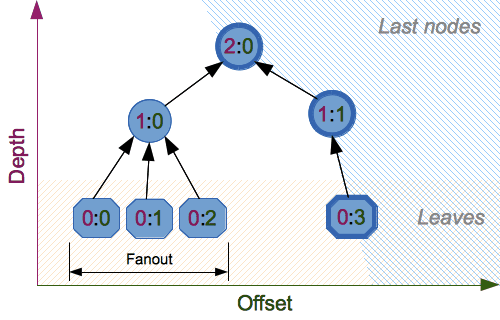
Constructor functions also accept the following tree hashing parameters:
fanout
: fanout (0 to 255, 0 if unlimited, 1 in sequential mode).
depth
: maximal depth of tree (1 to 255, 255 if unlimited, 1 in sequential mode).
leaf_size
: maximal byte length of leaf (0 to
2**32-1
, 0 if unlimited or in sequential mode).
node_offset
: node offset (0 to
2**64-1
for BLAKE2b, 0 to
2**48-1
for BLAKE2s, 0 for the first, leftmost, leaf, or in sequential mode).
node_depth
: node depth (0 to 255, 0 for leaves, or in sequential mode).
inner_size
: inner digest size (0 to 64 for BLAKE2b, 0 to 32 for BLAKE2s, 0 in sequential mode).
last_node
: boolean indicating whether the processed node is the last one (
False
for sequential mode).
See section 2.10 in
BLAKE2 规范
for comprehensive review of tree hashing.
To calculate hash of some data, you should first construct a hash object by calling the appropriate constructor function (
blake2b()
or
blake2s()
), then update it with the data by calling
update()
on the object, and, finally, get the digest out of the object by calling
digest()
(或
hexdigest()
对于十六进制编码的字符串)。
BLAKE2 has configurable size of digests up to 64 bytes for BLAKE2b and up to 32 bytes for BLAKE2s. For example, to replace SHA-1 with BLAKE2b without changing the size of output, we can tell BLAKE2b to produce 20-byte digests:
>>> fromhashlibimportblake2b>>> h=blake2b(digest_size=20)>>> h.update(b'Replacing SHA1 with the more secure function')>>> h.hexdigest()'d24f26cf8de66472d58d4e1b1774b4c9158b1f4c'>>> h.digest_size20>>> len(h.digest())20
Hash objects with different digest sizes have completely different outputs (shorter hashes are
not
prefixes of longer hashes); BLAKE2b and BLAKE2s produce different outputs even if the output length is the same:
Keyed hashing can be used for authentication as a faster and simpler replacement for
Hash-based message authentication code
(HMAC). BLAKE2 can be securely used in prefix-MAC mode thanks to the indifferentiability property inherited from BLAKE.
This example shows how to get a (hex-encoded) 128-bit authentication code for message
b'messagedata'
采用键
b'pseudorandomkey'
:
通过设置
salt
parameter users can introduce randomization to the hash function. Randomized hashing is useful for protecting against collision attacks on the hash function used in digital signatures.
Randomized hashing is designed for situations where one party, the message preparer, generates all or part of a message to be signed by a second party, the message signer. If the message preparer is able to find cryptographic hash function collisions (i.e., two messages producing the same hash value), then they might prepare meaningful versions of the message that would produce the same hash value and digital signature, but with different results (e.g., transferring $1,000,000 to an account, rather than $10). Cryptographic hash functions have been designed with collision resistance as a major goal, but the current concentration on attacking cryptographic hash functions may result in a given cryptographic hash function providing less collision resistance than expected. Randomized hashing offers the signer additional protection by reducing the likelihood that a preparer can generate two or more messages that ultimately yield the same hash value during the digital signature generation process — even if it is practical to find collisions for the hash function. However, the use of randomized hashing may reduce the amount of security provided by a digital signature when all portions of the message are prepared by the signer.
In BLAKE2 the salt is processed as a one-time input to the hash function during initialization, rather than as an input to each compression function.
警告
Salted hashing
(or just hashing) with BLAKE2 or any other general-purpose cryptographic hash function, such as SHA-256, is not suitable for hashing passwords. See
BLAKE2 FAQ
了解更多信息。
>>> importos>>> fromhashlibimportblake2b>>> msg=b'some message'>>> # Calculate the first hash with a random salt.>>> salt1=os.urandom(blake2b.SALT_SIZE)>>> h1=blake2b(salt=salt1)>>> h1.update(msg)>>> # Calculate the second hash with a different random salt.>>> salt2=os.urandom(blake2b.SALT_SIZE)>>> h2=blake2b(salt=salt2)>>> h2.update(msg)>>> # The digests are different.>>> h1.digest()!=h2.digest()True
Sometimes it is useful to force hash function to produce different digests for the same input for different purposes. Quoting the authors of the Skein hash function:
We recommend that all application designers seriously consider doing this; we have seen many protocols where a hash that is computed in one part of the protocol can be used in an entirely different part because two hash computations were done on similar or related data, and the attacker can force the application to make the hash inputs the same. Personalizing each hash function used in the protocol summarily stops this type of attack.
BLAKE2
was designed by
Jean-Philippe Aumasson
,
Samuel Neves
,
Zooko Wilcox-O’Hearn
,和
Christian Winnerlein
基于
SHA-3
finalist
BLAKE
created by
Jean-Philippe Aumasson
,
Luca Henzen
,
Willi Meier
,和
Raphael C.-W. Phan
.
It uses core algorithm from
ChaCha
cipher designed by
Daniel J. Bernstein
.
The stdlib implementation is based on
pyblake2
module. It was written by
Dmitry Chestnykh
based on C implementation written by
Samuel Neves
. The documentation was copied from
pyblake2
and written by
Dmitry Chestnykh
.
The C code was partly rewritten for Python by
Christian Heimes
.
The following public domain dedication applies for both C hash function implementation, extension code, and this documentation:
To the extent possible under law, the author(s) have dedicated all copyright and related and neighboring rights to this software to the public domain worldwide. This software is distributed without any warranty.
The following people have helped with development or contributed their changes to the project and the public domain according to the Creative Commons Public Domain Dedication 1.0 Universal: